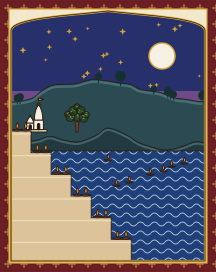
RagaAsavari thaatlate night
Raag Darbari Kanada राग दरबारी कान्हड़ा
Darbari Kanada, often just Darbari, is a late-night raga of Asavari thaat. It uses all seven notes, with Ga, Dha and Ni komal (flat). It is sung slowly and low in the voice, and its komal Ga and komal Dha swing slowly around their pitch. Looking for Shrilal Shukla’s novel Raag Darbari? This page is about the raga.
- Thaat
- Asavari
- Jati
- Sampurna–Sampurna 7 up, 7 down
- Vadi
- Re
- Samvadi
- Pa
- Sung
- Late night

The harmonium plays a line, then waits: sing it back in the gap.
The notes
Darbari takes all seven swaras. Ga, Dha and Ni are komal; Sa, Re, Ma and Pa are shuddha. These are the seven notes of Asavari thaat. All seven go up and all seven come down, but the way down turns back on itself, so its jati is sampurna–sampurna vakra (with turns).
- Aroha आरोह
- Sa Re G̱a Ma Pa Ḏha Ṉi Ṡaसा रे ग॒ म प ध॒ नि॒ सां
- Avaroha अवरोह
- Ṡa Ḏha Ṉi Pa Ma Pa G̱a Ma Re Saसां ध॒ नि॒ प म प ग॒ म रे सा
- Pakad पकड़
- Sa Re G̱a · Ḏha Ṉi Pa · G̱a Ma Re Sa · Ḍ̱ha Ṇ̱i Saसा रे ग॒ · ध॒ नि॒ प · ग॒ म रे सा · ध़॒ ऩि॒ सा
Re is Darbari’s most important note (the vadi), and Pa answers it (the samvadi). Sa, Re and Pa are where it rests. The way down has two turns: Ḏha Ṉi Pa, not Ṉi Ḏha Pa, and G̱a Ma Re Sa, not G̱a Re Sa. The pakad ends below Sa, on Ḍ̱ha Ṇ̱i Sa: much of Darbari is sung in the lower octave.Reading the sargamA dot below a swara puts it in the lower octave (mandra), a dot above in the upper (taar). A line under a swara marks it komal.
On the harmonium
With Sa at C♯, Darbari is C♯, D♯, E, F♯, G♯, A and B. With Sa at G♯ it is G♯, A♯, B, C♯, D♯, E and F♯. Set your Sa above and the keyboard lights Darbari’s keys from there; tap a key to hear it.
Darbari Kanada with Sa at C♯. Tap a key to hear it.
| Swara | Name | Sa at C♯ (kali 1) | Sa at G♯ (kali 4) |
|---|---|---|---|
| Sa सा | Sa | C♯ kali ek | G♯ kali chaar |
| Re रे | Re | D♯ kali do | A♯ kali paanch |
| G̱a ग॒ | Komal Ga | E safed teen | B safed saat |
| Ma म | Ma | F♯ kali teen | C♯ kali ek |
| Pa प | Pa | G♯ kali chaar | D♯ kali do |
| Ḏha ध॒ | Komal Dha | A safed chhe | E safed teen |
| Ṉi नि॒ | Komal Ni | B safed saat | F♯ kali teen |
A harmonium plays each note at one fixed pitch. Darbari’s komal Ga and komal Dha are not sung that way. They swing slowly and widely around their pitch: this is the andolan. Komal Ga is often called ati-komal, “extra flat”, and sung a shade below the harmonium’s key. How you come to it matters even more than its exact pitch.
So the harmonium on this page, and in Sangat, plays Darbari’s notes straight. Use it to find where the notes are and to sing the line in sur. Then listen to a singer for the swing.
How it moves
A raga is more than its scale. These are the moves that make Darbari sound like Darbari.
- Slow and lowDarbari lives in the lower and middle octaves. It is sung slowly, with long glides (meend) and slow swings, not quick ornaments.
- A slow swing on G̱a and ḎhaKomal Ga and komal Dha are held and swung slowly. Going up, Ga is touched from Re and Dha from Pa; coming down, Ga from Ma and Dha from Ni.
- Ḏha Ṉi PaComing down from the upper Sa, Darbari sings Ṡa Ḏha Ṉi Pa, not Ṡa Ṉi Ḏha Pa. Dha is often only touched on the way.
- G̱a Ma Re SaThe second turn: from Pa it comes down Ma Pa G̱a Ma Re Sa, rising to Ma again before Re. With Ḏha Ṉi Pa, this is the mark of the Kanada ragas.
- Down to Ḍ̱ha Ṇ̱i SaMany phrases sink below Sa and climb back to it: Sa, Ḍ̱ha Ṇ̱i Sa.
- Rest on Re and PaRe is the note Darbari dwells on most. Pa is its place of rest.
Ragas near Darbari
Darbari shares its notes with other ragas of Asavari thaat. These are the ones it is most often mixed up with.
| Raga | How it differs |
|---|---|
| Adana | Darbari’s notes and its turns coming down, but no Ga going up. It is sung high, around the upper Sa, and fast, and its Ga and Dha do not swing. |
| Jaunpuri | No Ga going up, and a straight way down with no Kanada turns: Ṡa Ṉi Ḏha Pa Ma G̱a Re Sa. A morning raga that lives in the upper half. |
| Asavari | Leaves out both Ga and Ni going up, and comes down without Darbari’s turns. |
Paltas in Darbari
Paltas walk a raga’s own line in small groups. In Darbari they keep both turns coming down, so every group is a piece of Darbari, not a plain scale.
Sangat has three palta sets in Darbari: pairs, threes and fours. They come with Sangat Pro, like the paltas of every raga but Yaman, Bhairav and Bhupali. Open Darbari in Sangat to see them; its About page is free to read.
Bandish in Darbari
Most Darbari compositions are khayals. The bada khayal is slow; the chhota khayal is faster. In tanarang’s collection, for example, the bada khayals are in vilambit Ektaal and most chhota khayals in Teentaal.
Sangat Pro has two Darbari bandishes from Geet Malika, the song pamphlets V. N. Bhatkhande edited from 1916: a lakshan geet in Chautaal, whose words describe the raga, and a chhota khayal in Ektaal. With Pro, both open in Sangat, where the harmonium plays them over the tabla.
Common slips
- Singing it high and fastQuick runs around the upper Sa pull Darbari toward Adana. Stay low, and take your time.
- A straight way downṈi Ḏha Pa, or G̱a Re Sa, loses the Kanada turns, and the raga drifts toward Jaunpuri or Asavari. Sing Ḏha Ṉi Pa and G̱a Ma Re Sa.
- Ga and Dha held stillSung dead straight, like the harmonium, komal Ga and Dha lose Darbari’s weight. Give them their slow swing.
Songs in Darbari
Film songs based on Darbari. Each is named as Darbari by at least two sources. Film songs often bend the raga, but humming one gets Darbari in your ear.
- Dil Jalta Hai To Jalne De (Pehli Nazar, 1945)
- Mohabbat Ki Jhooti Kahani Pe Roye (Mughal-e-Azam, 1960)
- Daiya Re Daiya Laaj Mohe Laage (Leader, 1964)
- Tora Man Darpan Kehlaaye (Kaajal, 1965)
- Jhanak Jhanak Tori Baaje Payaliya (Mere Huzoor, 1968)
Questions
What are the notes of raag Darbari?
All seven: Sa, Re, komal Ga, Ma, Pa, komal Dha and komal Ni, the notes of Asavari thaat. Re is its vadi and Pa its samvadi. With Sa at C♯ the keys are C♯, D♯, E, F♯, G♯, A and B.
What is the aroha and avaroha of raag Darbari Kanada?
Aroha: Sa Re G̱a Ma Pa Ḏha Ṉi Ṡa. Avaroha: Ṡa Ḏha Ṉi Pa Ma Pa G̱a Ma Re Sa, with its two turns coming down.
What is the pakad of raag Darbari?
Sa Re G̱a, Ḏha Ṉi Pa, G̱a Ma Re Sa, Ḍ̱ha Ṇ̱i Sa. Komal Ga and komal Dha are sung with a slow swing (andolan).
When is raag Darbari sung?
Late at night, after midnight: from 12 to 3 am in tanarang’s reckoning, and from 1 to 4 am in ITC Sangeet Research Academy’s time chart.
Who created raag Darbari?
It is said to be Tansen’s: tradition credits the singer of Akbar’s court with shaping it from the older raga Kanada. Darbar means a royal court. The novel Raag Darbari is a different work, by Shrilal Shukla.
What is the difference between Darbari and Adana?
They share notes and the turns coming down. Adana leaves out Ga going up, is sung high and fast, and does not swing its Ga and Dha. Darbari is slow, low and heavy.
Facts checked on 29 October 2026 against tanarang.com, Rajan Parrikar’s essay “The Kanada Constellation” at parrikar.org, ITC Sangeet Research Academy’s time chart, the NIOS course Hindustani Music (242) and Wikipedia. Each song is named as Darbari by at least two of Parrikar’s essay, Wikipedia’s list of film songs by raga and learnharmonium.com.